August 2026 Reviews
By Alan Dove
Three more kittens came through our panleukopenia stepdown facility this month. The shelter names them, and despite my suggesting a long list of outstanding cat names (the navigational stars and the moons of the solar system), they insist on using some truly bizarre ones. This litter, two female and one male, were Evan (female), Emmy (female), and Roberts (male). Though we weren’t fond of the name choices - I mean seriously, they could’ve been Aldebaran, Rigel, and Arcturus, but they got these names instead? - we enjoyed the kittens themselves. They kept me company for much of this reading.
Bennett, R.J., A Drop of Corruption: Having enjoyed the first book in this fantasy detective series back in January, I figured I should catch up with it again. Bennett’s worldbuilding is original and deep, and for these novels he’s created a believable empire built entirely around an existential threat. Each rainy season, immense leviathans crawl out of the sea, destroying everything in their path as they cross the land. Beyond just killing these bizarre creatures, though, the Empire of Khanum also depends on them, harvesting their blood and organs to distill all manner of medicines and “augmentations.”
This time around, the brilliant but eccentric investigator Ana Dolabra and her hardworking assistant Dinios Kol have been called to Yarrowdale, a politically precarious kingdom at the fringes of the Empire, where an Imperial official has been the victim of a classic locked-room murder. As the two dig deeper into the mystery, though, they find themselves chasing a criminal mastermind whose plans could be every bit as dangerous as the leviathans themselves. Sequels are often a letdown, and the start of this one seemed a bit slow. Once it got going, though, I zipped through the rest of its 450 pages in a day, and I’m looking forward to Ana and Din’s next adventure. The overarching theme of this volume, about the corrupting influence of power, was handled well in the story but spelled out a bit too tediously in the author’s afterword.
Eckert, J., The Traveler: Some speculative fiction authors like to go broad, cramming lots of ideas into a story. Others go deep, taking one concept and exploring all of its ramifications. This book is in the latter category. Scott Treder, a completely ordinary midlevel software engineer, is driving to work one morning when he first jumps forward in time, arriving 24 hours in the future. Suddenly he’s still cruising down the road at 25 miles per hour, but with no car beneath him. Bruised and baffled, he manages to recover well enough and reassure his horrified wife, and the next morning he arrives at work early. But at precisely 7:52am, just like the previous day, he jumps again, this time 48 hours ahead. The cycle continues, and each day in his life begins with a skip twice as far as the previous, hurtling him geometrically into the future.
For the first half of the book, the progression and Eckert’s world and character building work well. Treder’s preternaturally brilliant young son becomes obsessed with his father’s bizarre skipping, and the relationship between the two forms the emotional core of the book. As the skips get longer, though, the worldbuilding devolves into a series of cookie-cutter sci-fi vignettes, alternating between well-trodden dystopian and utopian visions of various futures. We get interplanetary warfare, societal collapse, and environmental disaster interspersed with flying cars, instantaneous biological engineering, and benevolent hive intelligences. There are few original ideas in the back half of the book, and the ending was a major letdown.
Marlow, J., The Dark Frontier: Nonfiction. Jeffrey Marlow, a microbiologist turned policy wonk and journalist, has focused his career on the deep sea, first as a scientist and then as an advocate. Skipping back and forth through both historical and geological time, he takes us on a tour through several kinds of darkness. First, there’s the inherent darkness of the abyss, the ocean depths thousands of meters down, where bizarre life forms thrive in conditions utterly alien to us surface dwellers. Then there’s the scientific darkness; we’ve explored only a minuscule percentage of this vast territory. And looming in the future is a dark threat of ruthless commercial exploitation, in which powerful interests are now jockeying to loot these poorly regulated places for short-term profit, likely causing damage that will take millennia to undo.
The scope is immense, and for the most part Marlow did a good job keeping me interested. I knew much of the material already, but was happy to see that he didn’t try to dumb things down. I haven’t thought that much about the electron transport chain in years, for example. The sections about policymaking are a lot less enthralling, and toward the end it felt more like I was reading the minutes of interminable meetings than a nonfiction book intended for general audiences. A little more summarizing there would’ve been welcome, and wouldn’t have reduced the impact at all. Still, it’s a well-crafted and immensely informative book, and anyone with the slightest interest in science should enjoy it.
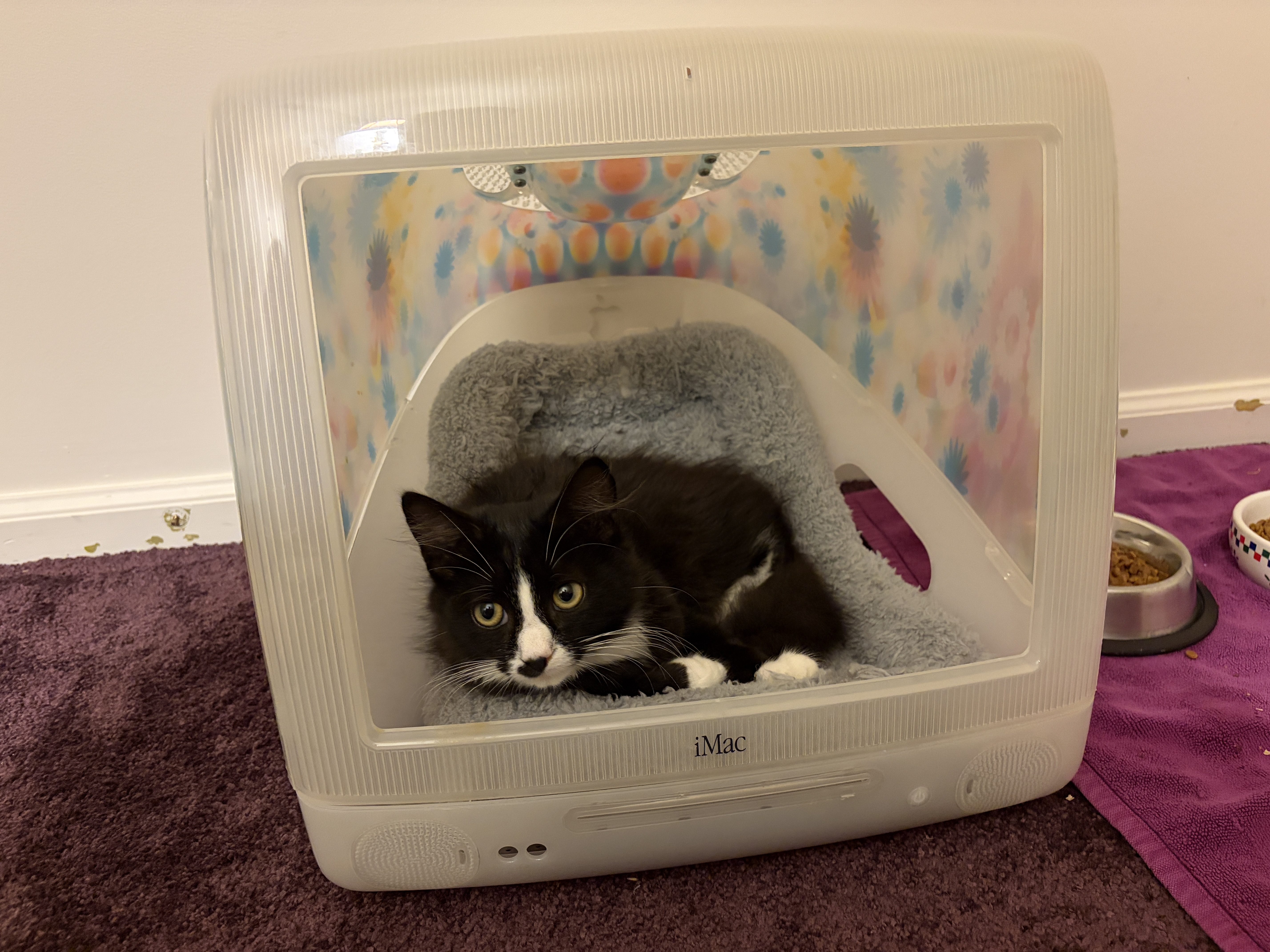 An old iMac serving its highest purpose.
Huang, S.L., The Language of Liars: In this short novel about language and culture, we meet Ro, a member of a highly empathic species who’s training to be a linguistic spy. In the secretive classrooms of the Warren, he seeks to master the language of an enigmatic species called Star Eaters, whose ability to find and collect the meridian element from interstellar space is critical for the operation of a galactic empire. But the goal isn’t communication, it’s possession, as highly trained members of Ro’s species can sometimes “jump” into a Star Eater’s mind, taking over its consciousness to become a perfect infiltrator.
I enjoyed the deep linguistic worldbuilding, and Ro felt like a believable character, a bumbling savant thrust into political intrigues much bigger than he expected. Once he comprehends the full scope of his mission, he struggles with the ethics of what he’s done, all while desperately trying to pass as a native in an alien culture. I saw the general shape of the plot a third of the way in, and by the halfway point I had a pretty good idea of how it was going to end, so the reveals lacked surprise. It was a fun way to pass a Sunday morning, even if it didn’t quite live up to the breathless hype it’s gotten.
Unferth, D.O., Earth 7: Raised in an underwater bubble habitat by her hermit mother, Dylan finally moves to the surface of the destroyed Earth as a young adult. There, she lives and works in a research facility that’s trying to preserve specimens of the planet’s fast-disappearing species. Interacting with other people is hard, but when her coworkers chip in to send her to an all-inclusive singles resort for a week, she falls in love with a woman who may or may not be a robot. Romance ensues.
Despite the bleak setting and my avowed dislike of postapocalyptic fiction, I enjoyed this. Unferth plays with some of the tropes of sci-fi, but deploys them in the service of something closer to magical realism. It’s surprisingly upbeat in the face of global environmental disaster, exploring the survival of love and hope even when everything else is gone. It reminded me of Emily St. John Mandel’s Station Eleven, but with a lot less plot.
Stringer, L., Grand Central Winter: Nonfiction. One day in the mid-1980s, a homeless drug addict was huddling under a train platform in New York’s Grand Central Station, in a little hollow he’d lined with boxes and turned into a makeshift home. Looking for a tool to tamp his crack pipe with, he found a pencil. Later, he found a blank composition book. In the following weeks and months, between highs, he wrote. Several years and multiple failed recovery efforts later, he had written himself out of addiction and homelessness and into full-time work as a writer and editor. These are his stories.
Stringer deploys his formidable wordsmithing skills to take readers through experiences most of us hope never to have. His perspective is as original as they come; you definitely haven’t read essays like these from the average bright-eyed MFA graduate. Living in the blast zone of the crack epidemic, he also served as editor of Street News for awhile, collected cans for recycling deposits, and took a few turns through the holding cells of Central Booking. Despite the outward bleakness of his circumstances, he also documents the little glimmers of joy and kindness on the streets. It’s a great read for anyone, but especially those of us who happened to live in New York City during that time period. I’m only sorry I never bought a paper from him.