July 2026 Reviews
By Alan Dove
We had another feline guest in July, and despite having seen a lot of kittens, we were impressed by how cute this one was. Seriously, 99th percentile cute. Chai was a bit more timid than most of our previous foster kittens, but after a couple of weeks she was a dedicated snuggler, at least when she wasn’t zooming around chasing cat toys. As usual, “needing” to spend time in the kitten room led to plenty of reading.
Tartt, D., The Secret History: This has been on my list ever since it was published in 1992. After Sophie read it, I was the last one in the household who hadn’t, so it was finally time. And wow. Yes, this book has gotten all the hype: international bestseller, origin of a new subgenre, appearance on every “best books” list ever. I can’t say whether any novel can live up to all that, but this lyrically written, page-turning inverse detective story and academic thriller was a great read.
The novel follows Richard Papen, a son of California blue-collar poverty whose love of classical Greek gets him into the fictional Hampden College in Vermont. There, he falls in with a close-knit group of Classics majors and their eccentric, charismatic professor. We know at the outset that there’s going to be a murder, and even know the victim, perpetrators, and circumstances, but unraveling the obsessions and interpersonal dynamics that led to it takes us on a heck of a ride. Tartt’s writing is gorgeous, most of her reveals are paced well, and the ending feels both original and inevitable. Her keen rendering of 1980s college life was a great nostalgia hit for me, and the deeper themes of elitism, isolation, beauty, and hedonism were strong enough to keep me thinking long after finishing the book.
Rogers, S., Your Turn! The Guide to Great Tabletop Game Design: Nonfiction. This continues something I started last month, studying analog game design. Rogers’s book may be the best general coverage of the topic available right now, though it does have some shortcomings. Starting with a useful classification of different types of board games, he then takes us through each in a consistent pattern. First, a brief history of that type of game, then a discussion of the mechanics (or mechanisms, if you prefer) that designers can use in creating such a game, and finally a tutorial that invites the reader to make a game of that kind.
Whether you’re interested in abstract strategy games, thematic “Euro-style” board games, card games, or over the top “Ameritrash” dungeon crawlers and wargames, this book covers it. It’s also a great reference. Indeed, after finishing the ebook I’d checked out from our local library, I ordered a hard copy for myself. All that said, the book suffers from the worst editing I’ve ever seen from a mainstream publisher. It has incorrect word choices, misplaced sentences, inconsistent usages, and grammatical gaffes every few pages. While I do suffer from a severe case of Proofreader’s Eye, I think even less picky readers will notice many of these problems. The information in the book is so useful that for someone interested in game design, it’s worth tolerating the awful copyediting, but I hope Rogers manages to get a qualified editor for his next endeavor.
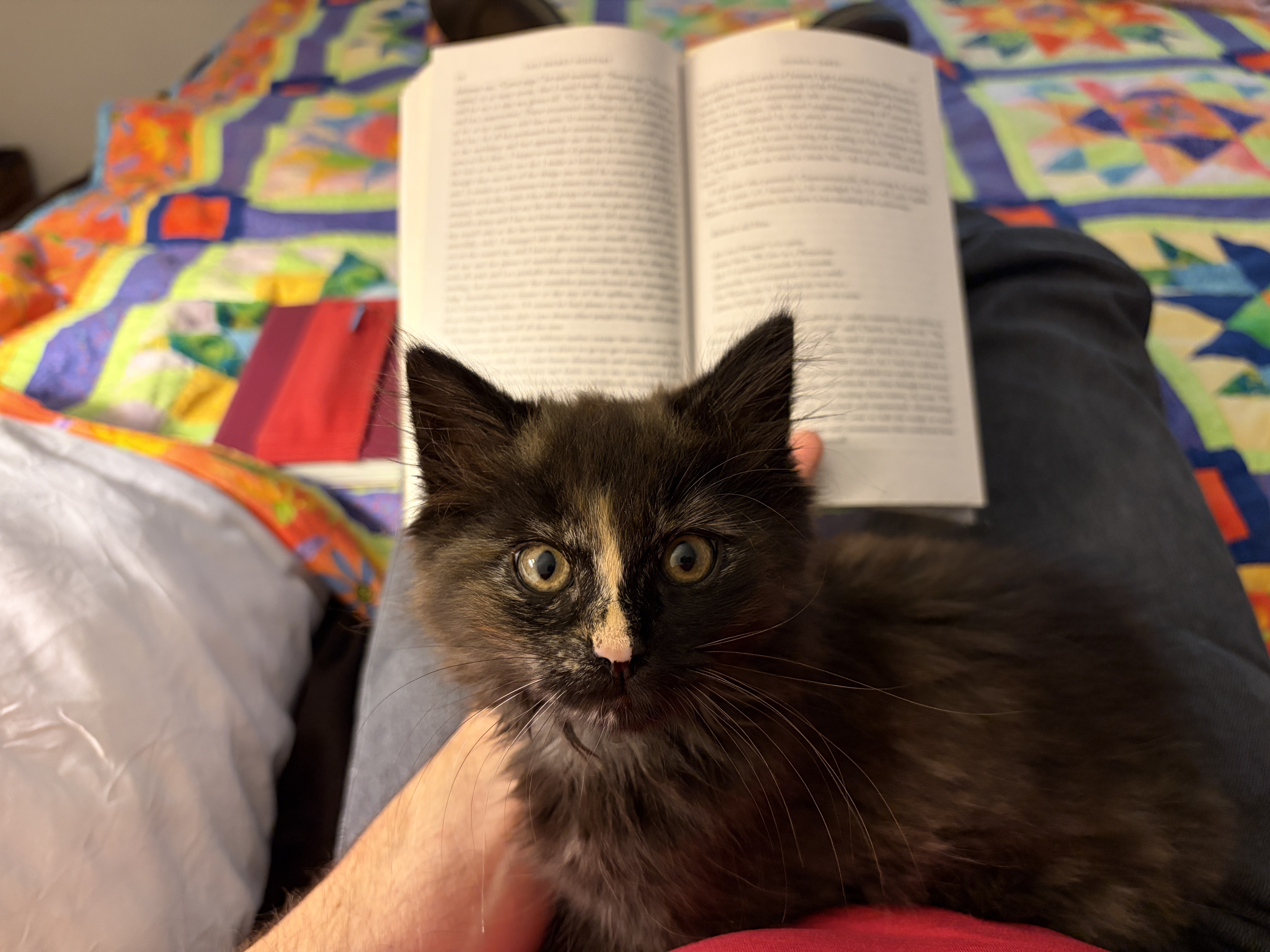 As I said, 99th percentile cute.
Priestley, R., and Lambshead, J., Tabletop Wargames: A Designers’ and Writers’ Handbook: Nonfiction. Yes, another game design book. I checked this one out from the library as an ebook as well, but don’t plan to pick up a hard copy. While I was hoping for a general book about a broad category of games, this turned out to be much more specialized and surprisingly weak. Priestley and Lambshead are legendary game developers, having done much of the design and writing for the massively popular Warhammer 40,000 tabletop games, so they should certainly know their stuff. I was surprised to see that they only sort of do.
To be clear, the book provides a deep dive into historical wargaming, and anyone interested in recreating Waterloo, Appomattox, or D-Day in their dining room will no doubt find some parts of this book fascinating. Priestley and Lambshead also provide a useful overview of some complex challenges in designing such games, such as the tricky problem of scaling troops and weapon ranges, and the fine balance between making an accurate simulation of a battle and making a fun game. Unfortunately, they don’t seem to understand even basic probability and statistics. I’m no math major, but certainly know better than to confuse p-values with probabilities, and their discussion of dice variance made no sense at all. Their advice on writing might be useful to someone with limited wordcrafting experience, but I found it weak as well. Overall, this was a disappointment.
Kean, S., Dinner with King Tut: Nonfiction. I’m not going to include the whole subtitle, which is practically a summary in itself; this is a book about experimental archaeology, the nutty field where people try to recreate ancient technologies and techniques. It’s a fun experiential journalism book, in which Kean racks up thousands of tax-deductible airline miles while exploring millennia of human history. He knaps a flint blade, brews Egyptian beer, throws a spear with an atlatl, tans a hide, fires a trebuchet, and tells us all about the people studying these and many other lost arts. Most of his adventures result in scrapes, bruises, and a general realization that there’s a reason we don’t do things the way our ancestors did. Ancient life was hard.
In order to flesh out these experiences, flex his writing chops, and, I suspect, pad out the book, Kean also intersperses his journalism with fictional accounts of ancient characters whose survival depends on the same activities. I’m sure those short stories were fun to write, but I found them tedious, predictable, and uninformative. By the later chapters, I was skimming through the fictional parts to get back to the good stuff: the real-life characters pursuing obsessive projects, often at the fringes of archaeology and history. It was a worthwhile read, but would’ve been better without the fluffy fictional filler.
York, C.A., The Salmon Cannon and the Levitating Frog: Nonfiction. The premise here seemed fun, and I certainly applaud the intent. York, a biologist, catalogs a series of real but seemingly silly scientific experiments, and then explains the major advances that stemmed from them. The book is intended as a response to the various political blowhards who have tried to call out “wasteful” expenditures of research dollars over the decades. Her point, which she hammers repeatedly, is that curiosity-driven research, even experiments that seem nonsensical at first glance, has been the engine for major advances across numerous disciplines for decades.
The stories are interesting, if you haven’t already heard them before. Yes, various groups of researchers have levitated a frog, developed a cannon to fire live salmon, timed how long elephants take to pee, and spent hours petting baby rats, all on the public dime. And yes, all of those experiments and more have led to discoveries directly relevant to healthcare, resource management, and other critical fields worth billions of dollars to the global economy. If you’re reading this book, though, you probably don’t need convincing about the importance of curiosity-driven research, and you may have heard many of these stories already. The format, which reads like a series of blog posts stapled into a book, does make a decent light read for short sessions. Since that’s exactly how I read it, I suppose it was fine.
Harrow, A., The Everlasting: This much-hyped book from a bestselling author just wasn’t for me. I expected a fantasy novel with a time travel twist, but got a romance between two flat characters I didn’t care about. The male lead is a sniveling putz the author takes every opportunity to emasculate, and the female lead is a wooden statue of an Amazon. The time travel gimmick is a literal hand wave. A hundred pages in, I decamped for other worlds.
Howey, H., Wool: A couple of friends recommended this bestselling series, so I picked it up despite my misgivings. My two least-favorite subgenres of speculative fiction are postapocalyptic and dystopian, so a postapocalyptic dystopia story seemed like a poor fit for me. It was. Besides being outside my usual thematic preferences, the story world also felt derivative, like it grew out of Fallout fan fiction. After the first novella, I walked away from the silo and haven’t looked back.
Scalzi, J., Redshirts: Following those disappointments, I needed a palate cleanser, and I knew just who could cook one up for me. This 2012 novel is one of John Scalzi’s most famous books; it won multiple awards and appears on numerous “best science fiction novels” lists, so of course it’s been on my own list for awhile as well. Believe the hype. Building on what Tom Stoppard did in Rosencrantz and Guildenstern are Dead, Scalzi takes on the existential quandary of minor characters in a classic sci-fi television series, with hilarious results.
Ensign Andy Dahl joins the crew of the Universal Union’s flagship Intrepid, and quickly learns that there’s something very weird about this prestigious posting. If you’ve watched more than a couple of episodes of Star Trek, you know the drill: two senior officers and a random crewmember in a red shirt beam down to an alien planet; guess who’s going to die a horrible death? The appalling casualty rate on “away missions” is only one part of the strangeness, though, and soon Dahl and his friends are on a madcap mission to save their own lives, or at least ensure that their deaths won’t be caused by lazy scriptwriting. If you’re even a casual sci-fi fan, you need this short novel. Stick around for the three codas, too.