April 2026 Reviews
By Alan Dove
If you’re tired of seeing the same two cats in these posts, even though they’re both awesome, I can guarantee at least one new foster kitten photo in the near future. Otherwise, here are reviews of the four novels and one nonfiction book I read in April.
Dinniman, M., Dungeon Crawler Carl: The aliens come and wipe out most of humanity in an instant. One of the few survivors is Carl, a 27-year-old Coast Guard veteran who happened to be holding his ex-girlfriend’s cat when the world ended. But far from being rescued, they’ve been chosen as contestants on a brutal galactic reality TV show, in which they must fight their way through progressively harder levels of a world-spanning dungeon, all the while keeping their viewership numbers up.
The setup promises a string of hilarious absurdities, and there are plenty of those, but Dinniman also manages to land some surpringly strong emotional beats, sharp social commentary, and deeper themes than most LitRPG works. This is the first of an ongoing series of books, and while the overall arc is quite predictable, the details are well wrought. Come for the talking, magic missile-hurling cat; stay for the morally gray choices and found family feelings.
Carey, M.R., Once was Willem: After my sojourn in the dungeon, I delved into a dark historical fantasy. Set in rural England during that country’s 12th century period of anarchy, this book follows a boy whose grieving parents hire a wizard to raise him from the grave after his untimely death. The resulting revenant is a hideous monster, possessed of the boy’s memories but with a grotesque body and a new consciousness. Shunned by his village, Once-was-Willem goes to live in the wilderness, where he encounters other strange outcasts. When the villagers’ own ethical lapses place them in grave peril, it falls to this monstrous crew to try to protect them.
The setting felt alive with details of medieval life, and most of the characters were complex and interesting. It’s a genre-blending mashup of fantasy, history, and horror, and I enjoyed its reworking of “Seven Samurai” tropes. Nor did it overstay its welcome. While the ending hinted at a sequel, one volume is enough for Once-was-Willem.
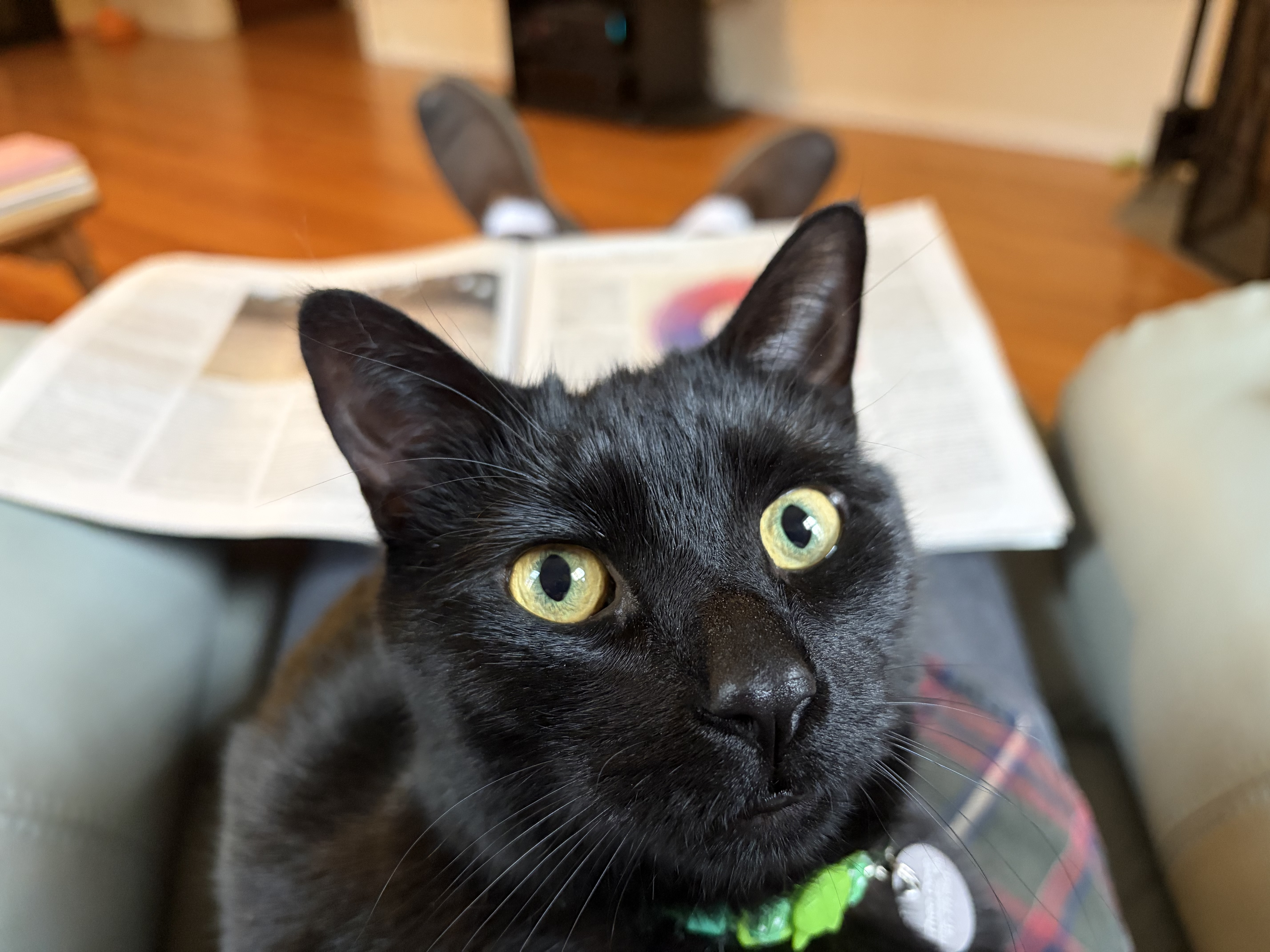 Theo offering to recommend a book from the latest NYT reviews.
Gabriele, M., and Perry, D., The Bright Ages: Nonfiction. I hadn’t planned to double dip into the Middle Ages, but my first gym read this month happened to overlap with the same time period as Once-was-Willem. Gabriele and Perry are historians of the period, and this book is a detailed rebuttal of popular misconceptions about the “Dark Ages.” Traditionally defined as the roughly 1,000-year period from the fall of Rome to the 14th century Italian Renaissance, this stretch of European history is the source of so many cultural tropes that the authors have their work cut out for them.
They’re up to the job, though. Building from primary sources without getting bogged down in them, they proceed chronologically, flipping almost every common idea about the medieval period on its head. Rome didn’t fall. The “barbarians” weren’t uniquely barbaric. Catholics, Jews, and Muslims only sometimes fought; other times they got along. Robust trade routes carried goods, people, and ideas across the whole of Eurasia and northern Africa. Ethnic, racial, and ideological diversity was everywhere. It’s an excellent work of popular scholarship, and also an important corrective for misinformation that still gets deployed to prop up noxious ideologies.
Jones, S.G., The Buffalo Hunter Hunter: In 2012, a workman opening an old wall discovers a tattered, century-old diary. Written by a minister on the Montana frontier, it records the bizarre confession of a Blackfeet native American named Good Stab. The premise, and the glowing reviews, drew me into a story that promised innovative twists on the well-worn trope of the vampire.
Sadly, the book didn’t deliver on that promise. I did get some well-researched Old West history, flawed characters with believable motivations trapped in horrifying situations, and lyrical prose, but the overall effect is diluted by way too much buildup. So. Damned. Slow. That might be tolerable if the story beats paid off, but they’re either completely predictable or annoyingly silly. By the end, when a character was killing a giant vampire prairie dog with a nail gun, I was just glad this slog was over.
Kwan, S., Awake in the Floating City: In the near future, climate change and sea level rise have turned San Francisco into a flooded, collapsing ghost town. Most of the residents who’ve stayed have only done so because they have no easy way out. Bo, a struggling artist, spends her days holed up in her apartment, as her family in the safe zone of Vancouver keeps imploring her to come live with them. Since her mother disappeared in a flash flood, though, she just can’t bring herself to leave. It would mean acknowledging that her mother is dead, and that the city she’s known all her life is gone.
When a supercentenarian in another apartment reaches out for help, Bo latches onto the job. Initially, it’s an excuse to postpone her departure, but as the two women get to know each other, it grows into something profound. The result is a beautiful story about memory, history, loss, attention, and what it means to care. Kwan is an artist as well as a writer, and it shows in her descriptions of Bo’s creative struggles. She’s also a keen observer of the way small connections can weave individuals into communities. The plot is a lot less flashy than most of the fiction I read, but the emotional beats, especially toward the end, hit hard.