Book Mini-Reviews for July 2025
By Alan Dove
My reading-instead-of-scrolling habit continues, and if I had entered my local library’s “Summer Reading” promotion, I’d be cleaning up on prizes. Here are short reviews of the six books I read in July.
Tchaikovsky, A., Children of Time: The themes are modern, but the subgenre is classic hard sci-fi, in this case with a focus on evolutionary biology and the inherent cruelty of long interstellar journeys constrained by special relativity. In the far future, the last remnants of humanity arrive at a planet that was terraformed during the days of the Old Empire. It looks like paradise: breathable atmosphere, a mix of oceans and continents, and covered in what seem to be unspoiled Earth-like forests. There’s just one catch: the terraforming didn’t go as planned. Instead of primates, another species has achieved sentience and built a civilization there. Can the humans learn to share?
The science is good, and I could empathize with the characters. My only gripe was that it ran a bit long, with considerable bloat in the midsection. It’s a good book, and would have been even better if there had been 20% less of it. Also, a content warning: while I love entomology, those who don’t might have some issues here.
Johnson, M., The Space Between Worlds: This is a multiverse story, with a cute twist. In the future, it’s possible to travel between parallel universes, and of course there’s a big company that’s turning a massive profit from extracting resources from other worlds. The limitation is that people can only travel to universes where their doppelgängers have died. Suddenly, those who’ve led risky lives at the fringes of society become highly valuable as world-walkers. Cara, who comes from the Mad Max-themed wasteland outside the glorious domed city, is a star among these highly paid errand-runners, having died on hundreds of other worlds. Now she lives in comfort alongside the privileged elite. Of course Cara has some dark secrets, her employer is far more dangerous than she realizes, and things go wrong.
The premise hooked me right away, and the characters are competently drawn. After awhile, though, the cookie-cutter worldbuilding and somewhat predictable beats started to wear thin. There were very few revelations I didn’t see coming. It was an enjoyable read, not a spectacular one.
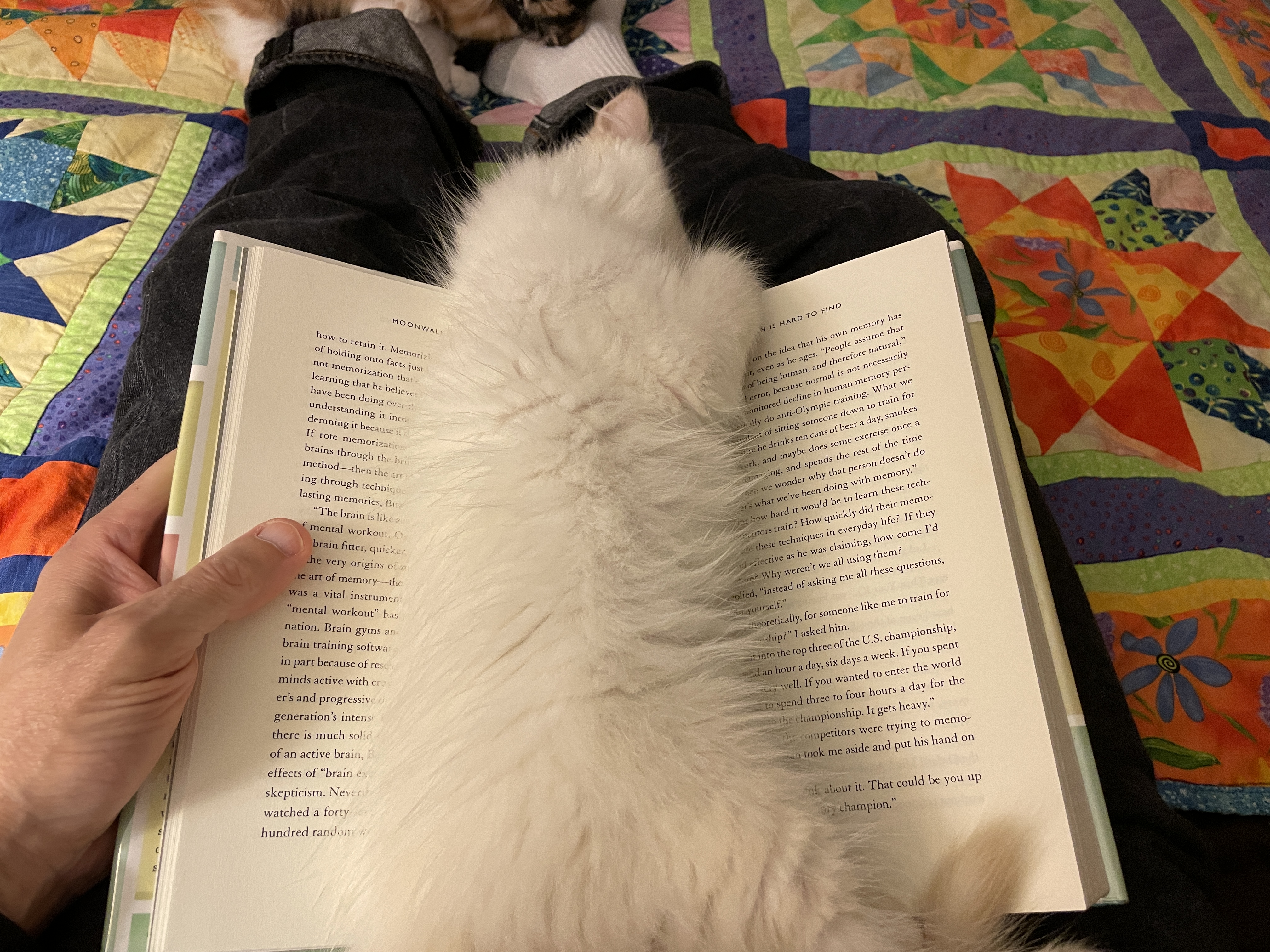 It’s important to have a good bookmark.
Foer, J., Moonwalking with Einstein: Nonfiction. This one’s been on my list for years, and by now it’s a classic work of experiential journalism. Foer attended a memory competition as a journalist, then got drawn into the small, eccentric world of the competitors. Under the tutelage of one of them, he spent the next year learning their methods, which turn out to be derived from ancient techniques that humans used for thousands of years, before universal literacy and cheap paper rendered them unnecessary. Along the way, he takes interesting digressions into the history of memorization, the neuroscience of memory, and some related philosophical questions.
If you just want to know how to remember more than you ever thought possible, do a few searches on “memory palace,” “memorizing names and faces,” and “mnemonic major system,” and you’ll get the basics. Other than names and faces, though, the techniques turn out not to be that useful in the modern world. And anyway, Foer’s journey from spectator to memory champion is what’s really worth reading about.
Knight, D., Creating Short Fiction: Nonfiction. Damon Knight is just here to serve Man. Yes, he’s the one who wrote that story, as well as numerous others, many of which are better. A pioneer of science fiction short stories, he was also a longtime teacher of the form in various workshops. He begins his pithy, practical guide with a list of reasons why he should not have written it, but I’m very glad he did. Short stories aren’t the same as novels; they’re much more constrained and therefore difficult. Beginning with the basics of character, setting, situation, and conflict, Knight then moves on to more advanced topics, with helpful exercises along the way. His section on the business side of short stories is hopelessly out of date, but everything else is timeless. If you have any interest in writing short fiction, it’s required reading.
Boldizar, A., The Man Who Saw Seconds: What if you could see the future, but only a little bit? Preble Jefferson can see five seconds ahead. He’s done exactly what one might expect with this superpower, making enough money from roulette wheels to live comfortably with his wife and child in a posh Brooklyn neighborhood, but otherwise he keeps a low profile. That is, until an unfortunate interaction with the NYPD goes sideways, and he finds himself the target of a manhunt. What is initially a local police problem escalates fast in the post-9/11 security state, and soon the feds want to capture him, either to use as a superweapon or eliminate as a threat to global order. The book is a blend of thriller and literary fiction, with a slightly sci-fi premise.
I loved the pacing of the thriller sections, especially the shootout. Jefferson is also a believable character, making what he thinks are the best decisions with incomplete information, too little time, and too few options. I wasn’t as pleased with the lengthy sections of neckbeard-stroking musings about institutional power and individual freedom. The ending is dark, but with the satisfying feeling of inevitability. Overall, a worthwhile read.
Gopnik, A., The Real Work: Nonfiction. The title comes from a term magicians use to describe what really goes into an illusion: the hours of practice and subtle nuances of presentation that turn a simple gimmick into a jaw-dropping effect. Ostensibly, the focus of the book is on what it takes to “master” a complex skill, with Gopnik following the fine tradition of experiential journalism to find out.
At least, that’s what I was expecting. What I got was a collection of essays that shared little more than a binding. Gopnik is an excellent writer, and some of the essays are quite good. I gather at least some of them appeared previously in The New Yorker, where he’s a regular contributor. Other times, he seems to be rambling. If you enjoy essays, and especially if you like Gopnik’s style, this is definitely worth picking up. Just don’t look for a coherent theme.