Reviews for October 2025
By Alan Dove
With “kitten season” over, our regular cats have resumed competing for my attention whenever I sit down to read. Theo, our snuggliest but also most mischievous, is especially keen to force me into awkward book-holding positions. Nonetheless, I read a detective story that veered into the supernatural, and a trilogy of dark fantasy books. During my morning workouts, I also read a very entertaining work of nonfiction on my phone.
Pinborough, S., A Matter of Blood: Laura and I have different reading tastes: sci-fi and fantasy for me, psychological thrillers for her. Nonetheless, we trade recommendations occasionally. She pointed me to this book, which starts off very much like her usual fare. Detective Inspector Cass Jones is tracking a serial killer and the perpetrator of a drive-by shooting, but then has to confront the apparent murder-suicide of his own brother’s family. The story world isn’t quite the one we live in, though, and as the plot develops, more and more fantastical elements creep in. It ends up being a very interesting genre mash-up. This is the first book of a trilogy, and I’m planning to get to the other two soon. However, another trilogy arrived in my library holds right as I finished this volume, so I switched worlds.
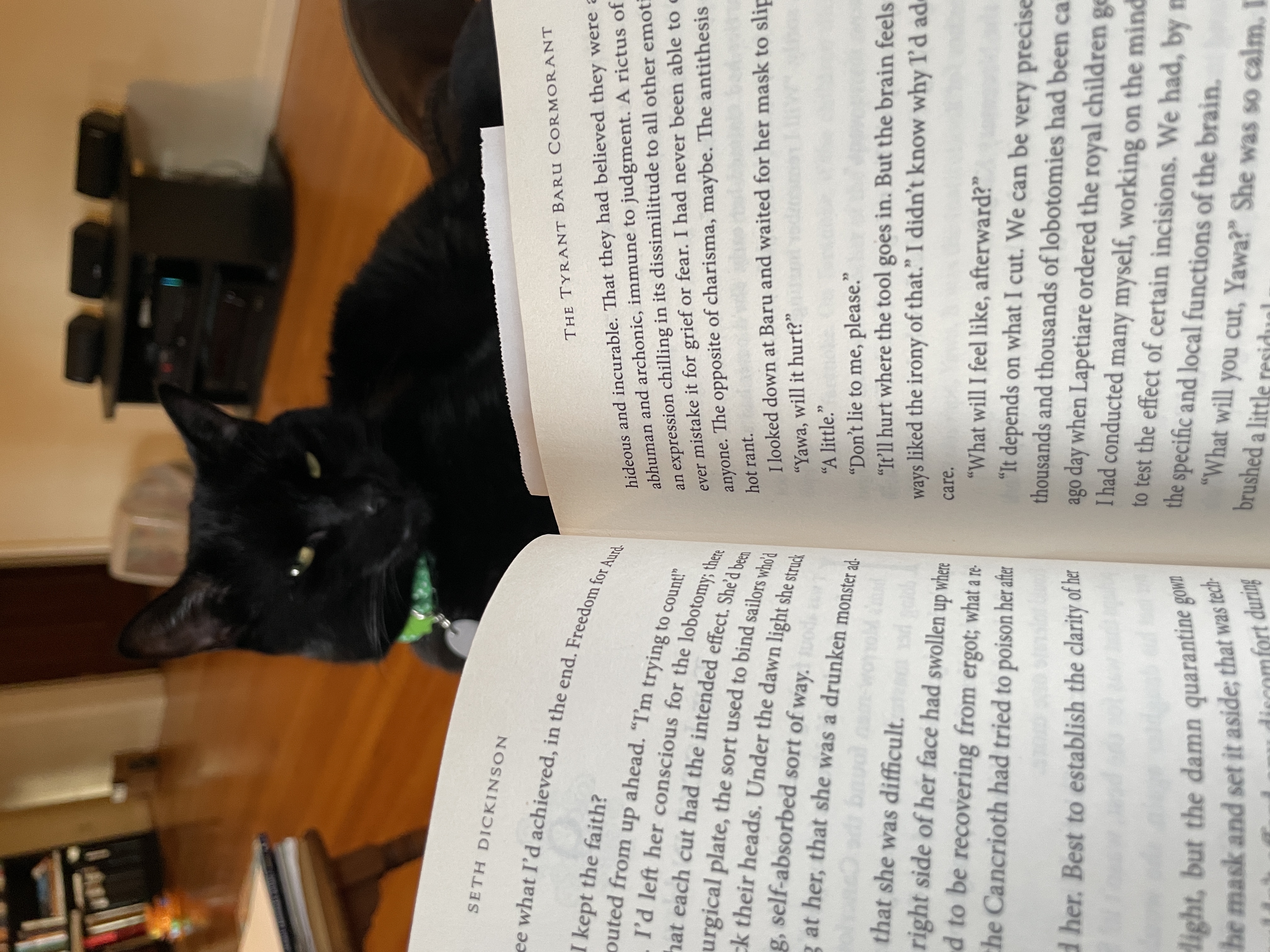 You can tell he’s planning something.
Dickinson, S., The Traitor Baru Cormorant, The Monster Baru Cormorant, and The Tyrant Baru Cormorant: Also known as the Masquerade series, this started off with one of the best books I’ve read all year. Dickinson’s debut novel after years of writing short stories, The Traitor Baru Cormorant presents a richly imagined, original world, compelling characters, and an utterly heartbreaking story. The genre is fantasy, but there’s no magic, or at least nothing that can’t be explained with some slightly stretched science. Baru Cormorant is a child when the Imperial Republic of Falcrest sends its ships to her island home. They conquer her people, not with swords, cannons, and spears, but with money, technology, and schools, erasing her culture and criminalizing her beliefs. She turns her brilliant mind toward defeating them from the inside, joining the Masquerade and becoming an elite technocrat. Then she has to help the Empire conquer another province to win their trust. But how far is she willing to go for her scheme, and will she be able to see it through? I saw the general shape of the ending coming, but not the devastating emotional impact of it.
After the first book, I was anxious to see how Dickinson would keep raising the stakes, so I plowed right into the next volume. Having accomplished the initial part of her plan at a terrible price, Baru becomes one of the cryptarchs, the secret rulers who control the Empire. Now, she’s scheming to start a war, playing a deadly game with the other cryptarchs, and struggling with her own divided mind and forbidden desires. The worldbuilding is outstanding, introducing more cultures and nations that feel real and lived-in. Ultimately, though, this felt more like a lead-up to something than the thing itself, and was a letdown after the first book.
There’s a point in a long story where you keep reading just because you’ve already read so much, and the sunk cost fallacy makes you feel like it would be a waste to stop. That’s all that pulled me through this third (but as I’ve since learned, not final) volume of the Masquerade series. At 650 pages, it’s half again as long as either of the other two books, and boy does it drag. The worldbuilding is still solid, the new characters feel three-dimensional, and the book has some fresh ideas and great writing. I loved the notion of a cult worshipping the immortality of tumors, the naval battles and sailing are well-researched, and the horrifying eugenic practices of the Masquerade are ripped straight from history. Unfortunately, it just doesn’t resonate the way the first book did, and while the ending isn’t a cliffhanger, it is defnitely open. Dickinson took a full-time job in narrative design for a big video game company shortly after finishing this volume. I think that may be a better use for his talents at this point. He says he’ll eventually write a fourth book to tie up Baru’s story, but I think I’m jumping ship now.
I’d love to recommend the first book to everyone, but am hesitant to do so because the second two are so lackluster. Maybe just read Traitor and make up your own extension of it in your head.
Fry, S., The Ode Less Travelled: Don’t worry, I’m not going to start flogging poetry on my readers here or anywhere else. I read this to address a gap in my education. Despite, or perhaps because of, the efforts of numerous English teachers to force poetry appreciation on me, I never enjoyed it. Fry takes a refreshing approach to the subject in this book. His stated goal isn’t to teach readers to analyze poems, but to write them. Deviously, though, his explanations of the elements and forms of poetry ended up doing a lot more for my understanding of verse than any of those school exercises. If you were also turned off poetry by bad pedagogy, give this a try.