A Book a Week, Six Months In
By Alan Dove
I’m not much for New Year’s resolutions, but I did start 2025 with some good intentions. One of them was to read more books, especially fiction. I used to read a lot of fantasy and sci-fi, but for many years my reading has tended more toward nonfiction science and how-to books, and not a lot of those. So I decided to get back to my reading roots.
It’s been going great, and looking at the list of what I’ve read so far, I realized it’s quite a pile. Here are my very short reviews from the first six months of the year.
First, though, a plug for local libraries. I make a generous annual donation to mine, which still works out to a tremendous bargain given my current rate of book consumption (I’m averaging more than a book a week). They have an easy-to-use online catalog, and I can request books from any library in central or western Massachusetts. My holds arrive at my local branch within a few days. I do also buy a book sometimes, just to support the author, but most of the ones on this list have been borrowed. Of all the entertainments available to us these days, this has to be the best deal available.
The list is in chronological order.
Breen, B., Tripping on Utopia: Nonfiction. A well-researched tour through the dawn of psychedelic drugs. Breen spends a bit too much time focusing on Margaret Mead’s role in this bizarre mix-up of postwar idealism, fringe pharmacology, and mysticism, but overall it’s an eye-opening look at a largely forgotten chapter of history.
Dick, P.K., The Three Stigmata of Palmer Eldritch: Philip K. Dick’s screaming acid trip of a sci-fi novel paired well with the previous read. While it suffers from many of the problems of the genre’s early days, this disturbing fever dream remains surprisingly topical, here in a dystopian world of technocrats hawking virtual realities.
Pratchett, T., Nation: Recommended to me years ago by a friend, this is nominally one of Sir Terry’s young adult books. Instead of his famous Discworld, we’re in the South Pacific, on an alternate Earth around the late 19th century. It’s a coming-of-age story full of piercing insights on culture, colonialism, and power. The perfect world is a journey, not a place.
King, S., On Writing: Nonfiction. This comes up in any discussion of books about writing, and now I see why. Stephen King’s authority on the topic is beyond question, and his nonfiction is as clear and compelling as his fiction. While his focus is on writing novels, the advice applies to any effort at wordsmithing. Start here, and you may not need any other writing books.
St. John Mandel, E., Station Eleven: This was so good I posted a separate review of it. An outstanding work of literary speculative fiction.
Black, J., You Can’t Win: Nonfiction. I downloaded this famous 1926 memoir of a hobo and thief as a free e-book, which I read on my phone while working out at the gym. It’s a fascinating view of a unique time in American history, told by an entertaining yarn-spinner.
Weir, A., Project Hail Mary: I enjoyed The Martian, but this is better. Andy Weir is one of the chief modern proponents of hard sci-fi, adept at working out realistic permutations of his premise. If that’s your jam, this story of an amnesiac science teacher who wakes up lost in space is a real treat.
Bear, E., The Stone in the Skull, The Red-Stained Wings, and The Origin of Storms (Lotus Kingdoms trilogy): Hugo award-winning author Elizabeth Bear sets this trilogy in a South Asian-themed region of her high fantasy world. She’s a master of worldbuilding, and the characters and their conflicts are compelling. The third volume is a bit bloated, and this might’ve worked better as a two-book series, but overall it was a fun read.
Buck, R., Life on the Mississippi: Nonfiction. I enjoyed Rinker Buck’s Flight of Passage, but hadn’t read any of his more recent work. With a trip to Natchez, MS on my calendar in March, I dug into this waterborne travelogue. The history of American riverboating was interesting to read about, and the somewhat silly modern voyage Buck takes to honor it is mildly amusing. By the end, though, I found his company tedious.
Meier, D., The Dung Beetles of Liberia: My mom knows the author of this memoir-turned-novel, and she sent me the book. Daniel Meier spent part of his early adulthood as a bush pilot in Africa, when Liberia and its neighbors were just gaining their independence from colonial rulers. This collection of anecdotes, connected by a gesture at plot, is a mildly entertaining ride.
Vandermeer, J., Annihilation, Authority, and Acceptance (original Southern Reach trilogy): The books that made Jeff Vandermeer and his “new weird” brand of speculative fiction famous. Annihilation is the best and shortest of the three, but the whole series is worthwhile. The worldbuilding is immensely imaginative, most of the characters are compelling, and the resolution satisfying in an unconventional way.
Addison, K., The Goblin Emperor: Katherine Addison’s worldbuilding is deep and broad, her steampunk high fantasy universe full of cultures and languages that could hold an entire franchise of stories. This book feels like an overview, full of courtly intrigue around a naïve young emperor that introduces us to Addison’s realm. I would’ve liked a bit more plot, but mostly enjoyed my time in the Elflands.
Scalzi, J., The Collapsing Empire, The Consuming Fire, and The Last Emperox (Interdependency trilogy): You like space opera? Hang this IV bag full of it next to your favorite reading chair and dump a bolus into your veins. John Scalzi’s fun, raunchy, cinematic, and surprisingly relevant Interdependency is a great place to spend a few volumes. It’s not hard sci-fi or high literature, but it’s definitely a good time.
Lynch, S., The Lies of Locke Lamora: Scott Lynch’s debut novel introduces Locke Lamora, the master con man of a sort of high fantasy-meets-steampunk Venice. Excellent worldbuilding; the city of Camorr feels like a real place. While I enjoyed my time there, by the end I was ready to say goodbye to Locke, whose routine had worn thin and whose motivations remained enigmatic. If you feel otherwise, there are more volumes in the series.
Martine, A., A Memory Called Empire, and A Desolation Called Peace (Teixcalaan duology): Arkady Martine’s literary space opera works on two levels: as a deeply imagined, highly entertaining adventure in an interstellar empire, and a thoughtful meditation on language, identity, culture, and colonialism. Come for the space battles and hive-mind augmented reality devices, stay for the court intrigue and social inquiry.
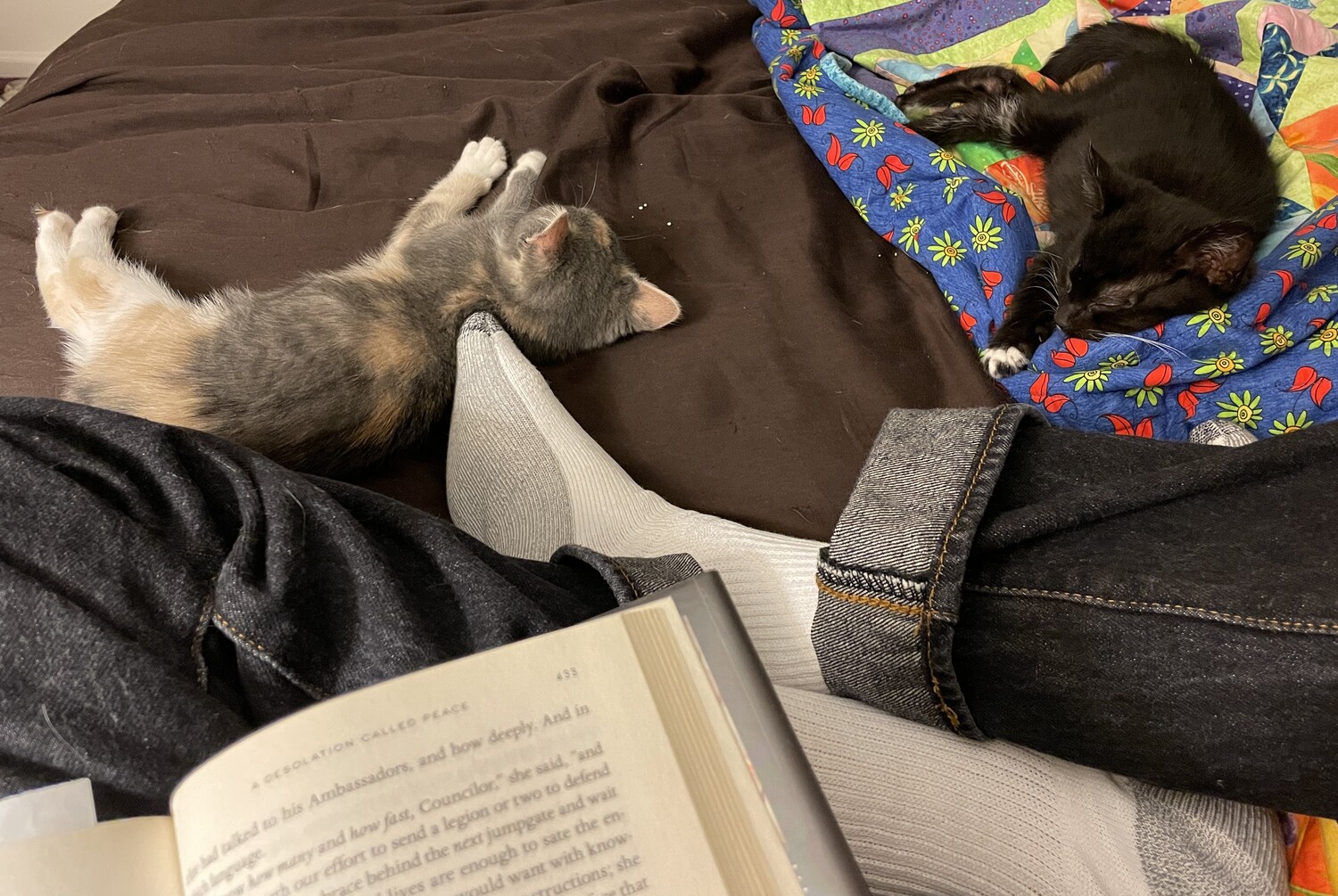 My idea of multitasking: socializing foster kittens while reading a good book.
Kingfisher, T., Nettle & Bone: Writing under her adult fiction pseudonym, Ursula Vernon weaves a dark fairy tale full of imagination. There are three sisters, a prince, a knight, a witch, a fairy godmother, and a very good dog, but these classic ingredients come together in entirely new ways. A tightly written story with a satisfying conclusion.
Shotts, W., The Linux Command Line: Nonfiction. This was the second free ebook I read at the gym. I’m pretty comfortable in a Linux console window already, but my knowledge has been cobbled together over the years. It was great to get a solid overview that filled in some of the gaps. If you use or plan to use Linux, read this.
Leckie, A., Ancillary Justice, Ancillary Sword, and Ancillary Mercy (Imperial Raadch trilogy): The main character of Ann Leckie’s extraordinary space opera is a thousand-year-old artificial intelligence that used to be an enormous spaceship, but now survives only in a single co-opted human body. And she wants revenge. A page-turning epic that’s also a thoughtful dive into identity and power.
Dick, P.K., Ubik: Another trip into the bizarre world of Philip K. Dick, this novel condenses most of his big ideas, loads them onto a train with no brakes, and sends it careening off the rails. What is reality, and why did my spaceship turn into a Model T? Who is God, and is he available in a spray can? I can neither summarize nor stop thinking about this book.
Christie, A., They Came to Baghdad: Mom, an avid mystery reader, recommended this one. It’s a departure from Agatha Christie’s usual cozy murder, and feels more like a spy thriller. Set in the Middle East at a pivotal time in the early 20th century, it was more or less contemporary when it came out but now reads as a fun slice of historical fiction.
Jemisin, N.K., The Fifth Season, The Obelisk Gate, and The Stone Sky (Broken Earth trilogy): Wow. I can see why all three volumes of this trilogy won Hugo awards. Nora Kelta Jemisin melds elements of sci-fi and fantasy into a deep seam of metamorphic rock, and brings together themes of culture and oppression with tectonic force. Even if you’re not a fan of speculative fiction, at least try this brilliant, deeply imagined series.
Schramm, K., The Compleat Meadmaker and Palmer, J., How to Brew: Nonfiction. Pretty obvious theme here: I used to brew beer a long time ago, and have been thinking of getting back into it. I’m still not sure I will, but these two books are excellent guides for anyone from beginning to semiprofessional zymurgists.
I’m still reading at the same pace and in the same genres, so in early 2026 I’ll post another long list of short reviews.