Silver Bells from Hiroshima
By Alan Dove
After World War II, my maternal grandfather was stationed in Japan, where he worked in the Army medical corps’ public health labs. His family, including my mother, lived on the base. Over just a few years, they accumulated quite a bit of stuff from this unusual historical period. Mom was cleaning out a closet recently, and texted an image of a small collection of children’s magazines she’d gotten there; my sister and I laid claim to them immediately. Jenn now has half the collection, I have the other half, and we’ll trade the next time she comes to visit.
So here’s a little sample of how children’s entertainment looked in occupied Japan:
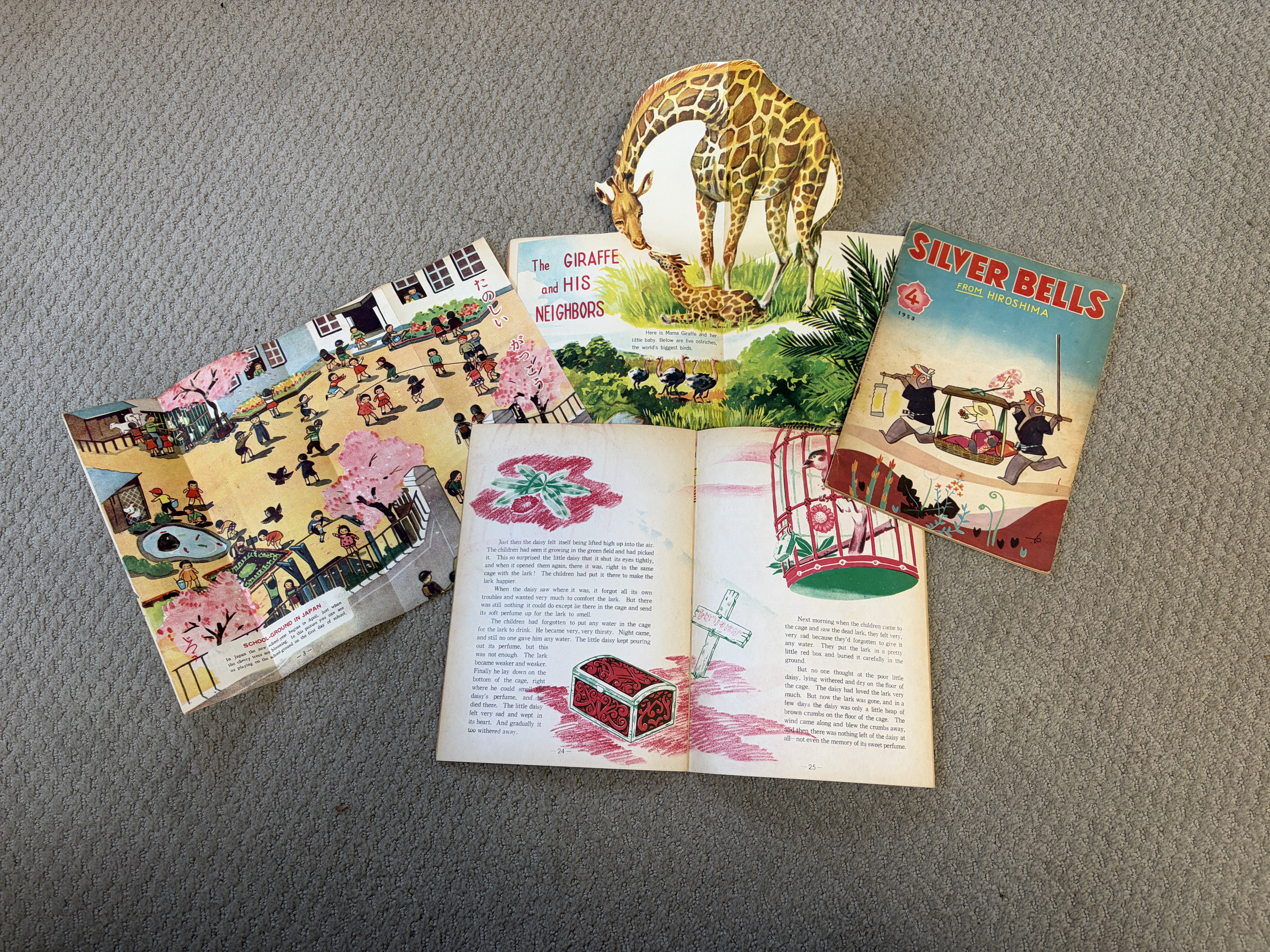 Blossoms rising from the ashes.
The first few volumes of the magazine are called Silver Bells from Hiroshima; later, the title changes to Silver Bells: Children’s Magazine from Japan. The story, summarized in one of the early volumes, is that Tomikazu Matsui, owner of the largest printing plant in the city of Hiroshima, was biking to his office on the morning of August 6, 1945, when the bomb fell. In an instant, his city was incinerated, his presses and building destroyed, and many of his employees and their families killed. There’s a strong argument that he and his compatriots were the victims of one of the worst war crimes in history.
Mr. Matsui’s response was to rebuild his plant and start printing a magazine “unlike anything Japan had seen before.” Aimed at children and published in both Japanese and English, each little volume offered retellings of traditional Japanese folktales, descriptions of Japanese life, and subtle promotion of progressive democracy. Charles E. Tuttle Company of Vermont helped with translation and distribution to Americans.
There’s some darkness here and there, such as the story of a lark and a flower who both end up with sad deaths, but it’s no worse than an uncensored Grimm fairy tale. Most of the illustrations and stories are full of optimism and hope. The artwork varies in style and quality, with most of it leaning toward a simple cartoon style that looks like a forerunner of later manga comics.
What surprised me most was that there’s very little information online about these fascinating little artifacts. I did find one blog that includes scans of a full issue, and of course eBay and Etsy have many copies for sale. Much of the available information about Mr. Matsui comes from a single Time magazine article about him and his magazine, but access to that seems to have fallen offline with that publication’s many changes of fortune.
So here’s to Mr. Matsui and Silver Bells. In a dark time, you found some light, and did what you could to shine it on others.